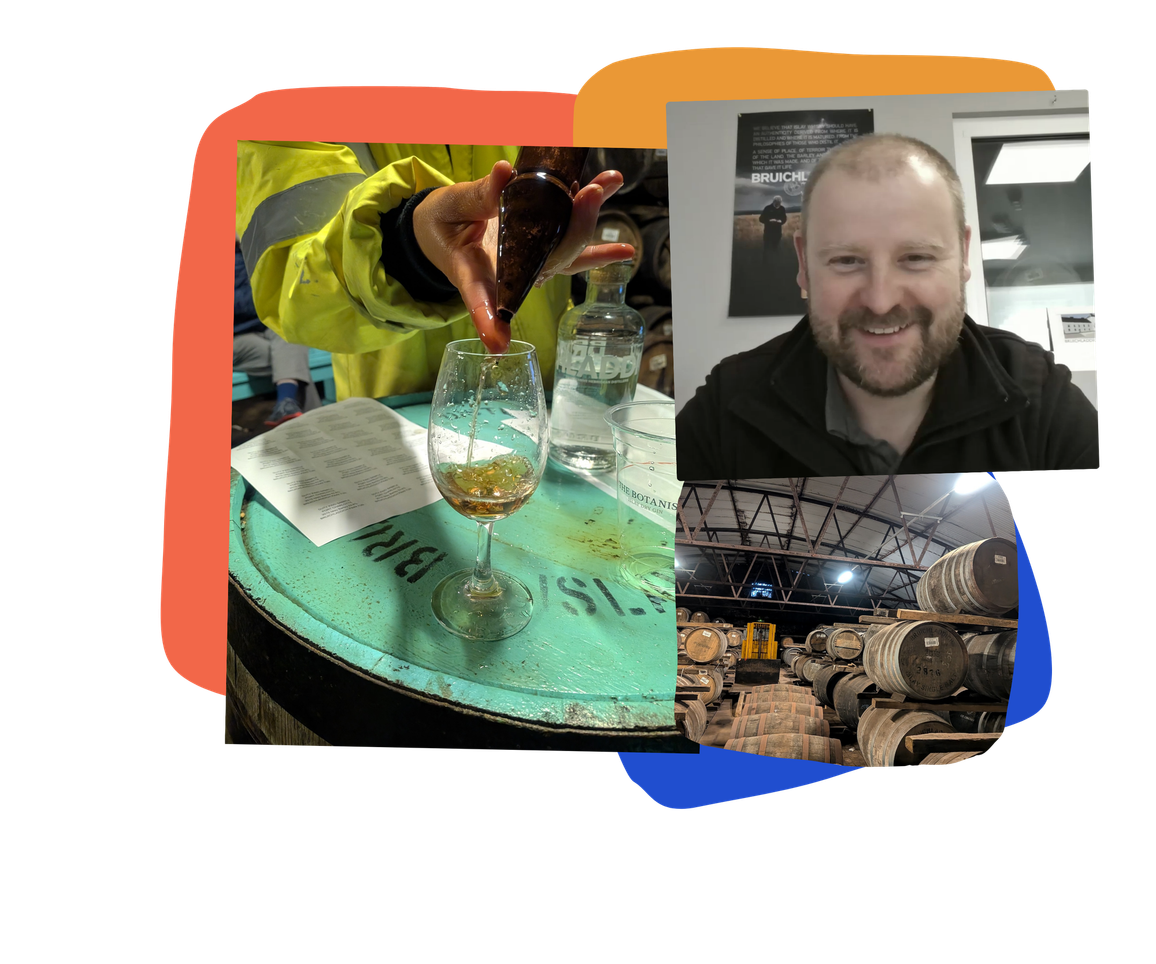
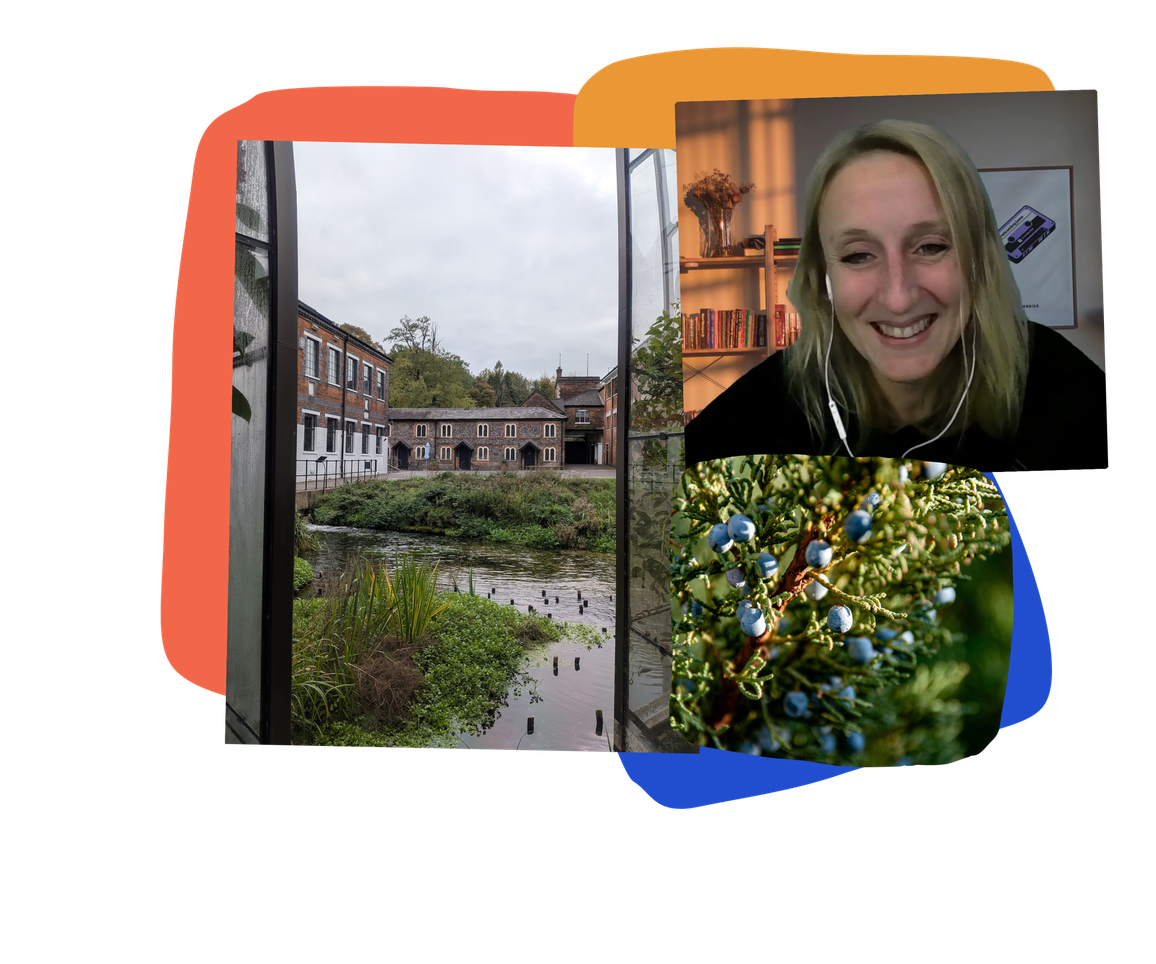
Blended Scotch Whisky

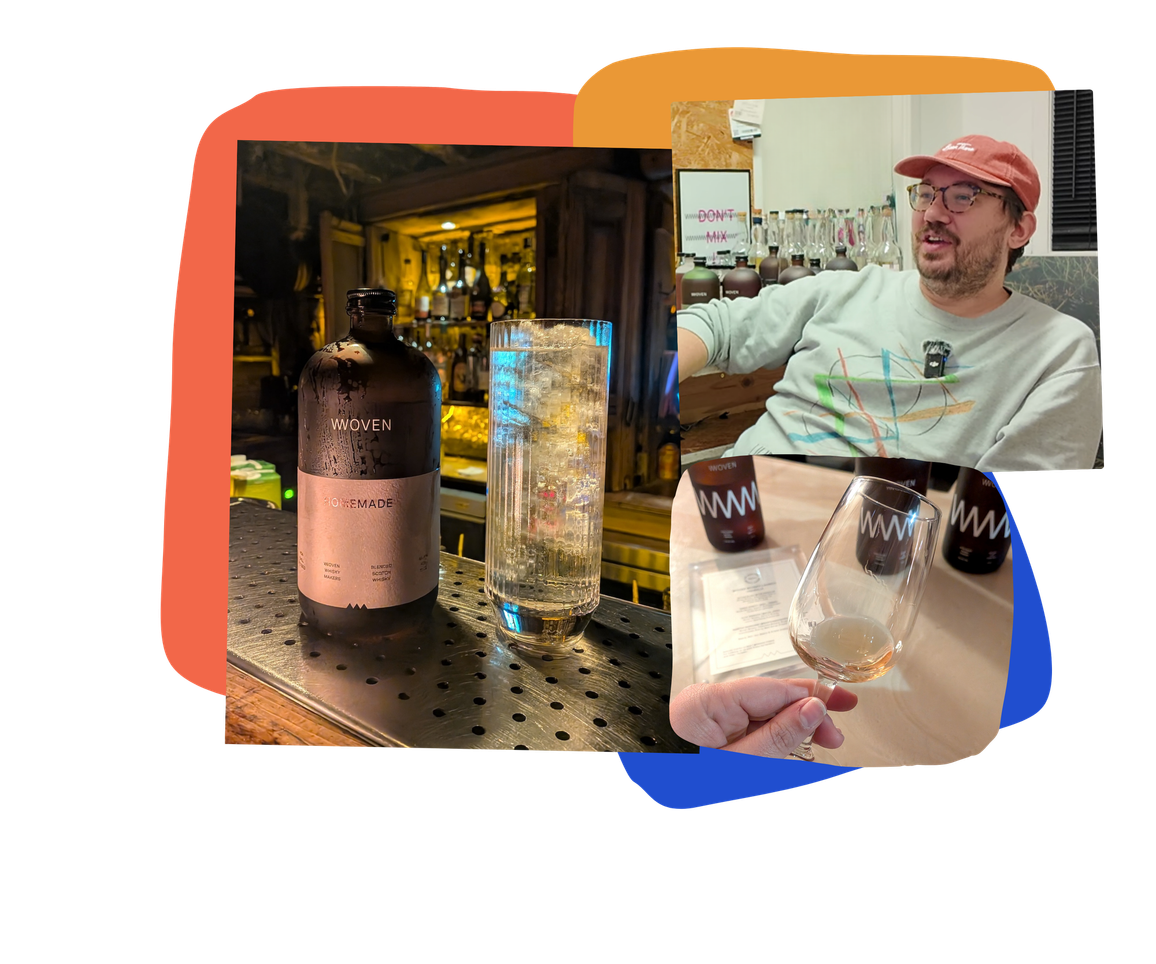
I went into this episode with the same bias most people have: blended Scotch is the well drink, the thing you order when there's nothing better. Single malt is where the craft lives... right?
Then I sat down in Leith — the old whisky-trading port of Edinburgh, where wine merchants and grocers started blending casks by hand back in the 1800s — with Pete Allison, co-founder and Head of Whisky at Woven, a blending house that doesn't own a single still.
We get into how blending actually works, why Pete sources whisky from South Africa to Taiwan, and why he'd argue blending — not distilling — is the most creative job in the entire industry.
By the end, you won't look at a blended Scotch the same way again.
Blended Scotch Whisky
Listen to this episode to hear all about:
- Why blended Scotch (not single malt!) is the original whisky, and still outsells it more than 5 to 1
- How Victorian-era grocers in Leith invented blending, and why that neighborhood is still ground zero for it today
- Why Pete thinks blending is the most creative job in whisky — "creativity through constraints," not a blank canvas
- How a blending house with zero stills builds flavors Scotland alone can't, using whisky from countries that haven't historically made it
- And why "pop it, throw away the cap" might be the most respectful thing you can do with a great bottle
More from this episode
Transcript
Show Intro (0:00)
Welcome back to Between Drinks. I'm your host, Caro Griffin - here to share the stories behind your favorite drinks and the people and places who make them what they are.
This is Season 3, which means we're in the UK.
Last episode, we were in London, diving into the colorful history of gin. This week, we're heading north — to Edinburgh, and specifically to Leith, a neighborhood that was, for a long time, the epicenter of the Scotch whisky trade.
We're talking blended Scotch. A category that accounts for more than 85% of all whisky sold around the world, and is still, somehow, considered the lesser option.
Today’s guest and I are here to push back on that.
-
It’s kinda funny that I’m following up a season in Japan with episodes in Scotland because I see a lot of similarities between them. Maybe not on the surface, but definitely when it comes to tourism.
They are both bucket list places for a lot of folks. Where even people who’ve never been can name a few cities, towns, or points of interest. Where you go for as long as you can, to see as much as you can.
For me, that was about five weeks. I started in Glasgow, made my way to Islay, a tiny island known for its whisky, before taking the train to the picturesque capital of Edinburgh, and then up to the Highlands, home to a different style of whisky, and then back to Edinburgh for a nightcap of sorts.
I got around, is what I’m trying to say. And I talked to a lot of people in and around whisky.
Which, here, has a long, storied history…
-
Pete: Our ambition is that if you were to write the story of whisky, we could be a footnote or a paragraph or a chapter, whatever it ends up being. But we're not going to be lost because we are trying to do something different.
Episode Intro (01:48)
That was Peter Allison, a co-founder of Woven Whisky, where he’s the Head of Whisky and master blender.
Blended whisky is often thought of as a cheap, subpar product, but it’s actually the original whisky, and it's still the most widely consumed whisky in the world by a mile.
But somewhere along the way — somewhere in the last forty years of single malt prestige and fancy age statements — blended whisky got demoted. It became the well drink. The bottom shelf. The thing you mixed with Coke at the dive bar that doesn’t have anything better.
Which is a shame, because blending is genuinely one of the most complex and creative things you can do in whisky. And nobody I've talked to makes that argument better than Pete.
-
Pete: Blending for us has always been this incredible, creative aspect of whisky that never gets the spotlight shone on it. And we believe, and we maintain, and certainly more than believe now, that blending is the most creative part of the entire whisky-making process.
You're able to augment, challenge, and change, and manipulate flavour to what you want your whisky to taste like as opposed to making it through distillation and time, which is much harder, but it's also much less… You can't design it; you have to sort of make it and trust.
Caro: It's creativity through constraints instead of like a blank canvas.
Pete: Yeah, exactly. And that idea of being able to start with a canvas and be able to build up a flavor profile that you want to drink from that was super, super appealing…
History of Whisky (03:30)
Whisky is one of the best-known spirits, the world over.
People in the British Isles have been making it for about five hundred years, which is… wild, when you think about it.
For most of that history, it was made illicitly — small stills hidden in hills, in barns, anywhere the taxman wasn't looking. The Excise Act of 1823 changed that, dramatically simplifying the licensing process and making legal production viable for the first time.
From there, the industry formalized quickly. And out of that newly legal era came an unlikely group of innovators: Victorian-era grocers.
In the mid-1800s, wine merchants and grocers across Edinburgh and Leith started buying casks from multiple distilleries and blending them — partly for consistency, partly to create something more approachable than the raw, often harsh single malts of the time.
And once grain whisky — made from corn or wheat, much cheaper and faster to produce — arrived on the scene, blenders suddenly had a lot more to work with.
Which brings us to Leith. And why Pete and his co-founders, very deliberately, decided to build Woven there.
-
Pete: Yeah, so… Scotland has been producing whisky, illicitly or legally, for sort of 500 years, something incredibly long.
You know the thing with Scotland is that it has an incredibly beautiful but hard-to-manage terrain, and so you have distilleries that catered for small pockets of people in far-flung locations, making whisky that tasted like their area, because you had the barley grown there, you had the water, etc. And that was great. Absolutely fantastic. But whisky grew in popularity. And eventually, you had to sort of consolidate whiskies in order to send them out, or to send them down to England, or even just to consume in Edinburgh and Glasgow. And one of those points of consolidation, literal consolidation, where trains and wagons would come into the city, was Leith.
This is the old trading port of Edinburgh, the most northerly part of Edinburgh, right on the shore here, and you had whiskies from all over Scotland coming in, and you also had barrels of wine, brandy, rum, sherry, very importantly Madeira, coming in from the ships. And, so, it was a natural point to start blending whisky here on these shores, and with the advent of grain whiskey, it became the ability to sort of standardize flavors and be able to create en masse really great tasting, really superbly complex and lovely blends that became famous.
And so, from, literally, where we can see, you have the Hague Distillery there, which is uh, where the old Hague and Dimple was made, you have the Paterson Bonds behind us, which is where a couple of brothers were up to some hijinks, started their empire, and eventually crashed the lot. That's history too far.
You also had Dewar’s, VAT 69, Black and White, Johnny Walker, Chivas, all being made, produced, bottled by teams of people that would be local to Leith and put into these ships and travel around the world, and so… Leith, from our blinkered perspective… You might talk about Speyside or Campbelltown or Islay being the heart of whisky, but if you want to get a true picture of Scottish whisky as a whole, then you need only be in these sort of 10 square miles from North Edinburgh and look at its history and go for a walk. Because there’s going to be bonded warehouses, old buildings that have the designs of the brands that you've never heard of but existed, and they were huge once upon a time.
And that industry sort of grew and grew and grew until Edinburgh became too expensive. And, you know, highways and railways and all this sort of stuff made it more convenient to be able to build massive blending facilities in more central Scotland than it was to make it in a small area of Edinburgh. So, although the advent of blending in Leith grew over a long time, the decline of whisky in Leith happened very quickly, in sort of a 30-year period. And we were absolutely hell-bent in building Woven in Leith because, for us, this is the home of blending; this is where we wanted to be.
-
Before I went to Edinburgh for the first time, people described Leith as the city’s Brooklyn… and that’s probably fair? I don’t know. There are definitely great bars, cafes, and shops. Creative people doing creative things in an area that hasn’t lost its industrial feel.
But it also made me picture the Brooklyn of today, or even Brooklyn from even ten or fifteen years ago, and Leith doesn’t feel like it to me—at least not the central parts.
It’s smaller, and at the same time less dense, and you can feel the history that Pete is talking about on its streets - old buildings with painted walls advertising once-famous brands I had never heard of until I started interviewing whisky nerds for this episode.
You can feel the history, is what I’m saying, and you can feel it in a way that I think hits particularly hard for North Americans. I mean, people have been blending whisky in Leith longer than my entire country has been around.
And so, to call back to Pete’s early comment… what a history to be a footnote in.
Starting Woven (09:38)
Woven Whisky was founded in Edinburgh in 2021.
I first tried their blends at the Helsinki Whisky Festival — which is, I realize, a very roundabout way of finding a new favorite Scotch. But that's how this works sometimes: you're tasting your way through a long table of samples, and something makes you stop.
I talked to someone on their team, we exchanged details, and then, about a year later, I slid into their DMs and asked if Pete would want to be on the podcast.
And I'm glad he said yes—because what I didn't know yet, when I was enjoying that first dram in Helsinki, was how clearly and thoughtfully Pete thinks about what he's doing, and why.
Starting a whisky brand from scratch — one that blends rather than distills, that doesn't own a single still — is not the obvious path. So, I asked him what that was actually like.
-
Pete: It was a really interesting time, and I do look back on it genuinely with rose-tinted glasses now, but I think the reality was quite hard.
Part of that was due to the time. We were talking about setting up and trying to buy whisky during lockdown. The whole world was behind masks and sitting indoors, and Whisky had no idea what was going on. There was a huge demand, but supply had constricted, so all of the distilleries and brand owners were saying, “No, you can't have whiskey because we need it to release.” And so we find ourselves kind of… looking for bulk blending whiskey… but in incredibly small volumes.
When somebody says, “I'm blending whiskey,” you go - big ticket, here we go, it's gonna be massive volumes and we're gonna be… You know, it might not be the most expensive, but we're gonna have income all the time, and we were there going… “Do you have half a cask?” [Caro laughs] “Can we, you know, do you have any remnants that we can take?”
Caro: Can we just throw it in our truck and take it home?
Pete: Pretty much. The obvious answer from nine out of ten was just to say, 'Sorry, but no.' And so we actually went to a former employer, and they were able to help us out with that initial whiskey stock, which we purchased very eagerly and were able to put it together.
But you know, we had other issues, like the bottles. You know, we wanted to be in this very aesthetic, tactile, small brown apothecary bottle called the Boston Round, but trying to source that bottle was very difficult because the… It's actually the most common bottle in the world, believe it or not. The 50 CL one, or the 1 litre is… but we wanted it in very small volumes. And so they said no.
We had to find a supplier in China that was able to do small volumes and do the screen printing on it. So, we had a lot of different challenges, and I think that it was a bit of naivety and a bit of sort of, “Well, why can't we?” attitude that meant that we were able to kind of ask those awkward questions to the point where they kind of relented and said, okay, fine.
But starting the business, there's a lot of legislation compliance and documentation that you have to go around it. But, because we're blenders, and we don't own our production facilities, it was, it was a bit more straightforward. I've never had experience in designing and building a distillery, but I'm sure that's, that's a lot harder.
And for the record — after all of that — Pete would do it again.
Pete: Yeah, I think I definitely would. I think everyone should start a booze brand. It’s the most fun you can do.
Understanding the category (13:30)
Blended whisky is one style of whisky, so let’s quickly break down the category so we’re all on the same page before we go any further.
Pete: Yeah, so blending is… exactly what it says on the tin. It's combining various whiskies together to create a new single whiskey in the glass.
So, you would use a mixture of both single malts, i.e., made with 100% malted barley at a single distillery, aged for three years in barrels using copper pot stills, and you'd combine that with grain whisky that uses things like maize or corn, rye, wheat, as well as barley.
And it would go through a much more industrial distillation process where you get higher alcohol, more neutral spirit coming out, but then you age it the same as malt whisky for three years. And you have sort of this— these two sort of sides of whisky, where you have soft grain, you have complex malt, and by combining them together, you're able to create a blended whisky.
Very famous examples would be Johnny Walker, Famous Grouse, Grants, Chivas, Ballantine’s. And blended whisky from Scotland still accounts for over 85% of the whisky sold in the world.
And so it's a process that has a lot of history, a lot of peerage and respectability within the industry. However, you know, over the last 40 years, since the 80s, single malts have dominated in terms of the limelight and also the price.
So before the 1980s, it was all about blends. I mean, your genuine big shot names, Macallan, Glenfiddich— all these mainly going into blended whiskies. And since the 1980s, that… you know, it's become more about the price, more about the homogenization of flavor.
So, you're getting a whiskey, but you're getting a whisky for a cheap price, and you're getting it en masse. So, it's the supermarkets, it's the well drink, it's the stuff you know, whatever you call the well drink, the speed rail drink… and blending has become, you know, a huge business—many, many, millions of bottles sold every minute or something. But, you know, [whereas] single malts have taken the limelight in terms of their price and, prestige? Blends have kind of gone down.
-
Before we get into the mechanics of how Pete actually does the blending, two things worth knowing that'll make everything to come click a little better.
First: casks.
In whisky, the liquid is aged in casks, and those casks come in different sizes. Technically, a barrel is just one size of cask… but arguably the most common one, so you’ll hear people refer to cask and barrel kind of interchangeably in casual conversation.
- Ex-bourbon barrels, once used to age American bourbon, are the most common. Bourbon producers can only use their barrel once so there’s a whole secondary market for these. They tend to add vanilla, honey, lighter notes.
- Sherry casks are prized for dried fruit and richness.
- And then there’s port, wine, rum — they all bring their own character.
Cask selection is one of the central levers a blender has to work with. And the size of the cask, and how many times it's been used, and so on… affects how fast the whisky takes on flavor.
Second, we have the business of blended whisky.
The big names — Johnnie Walker, Ballantine's — these are owned by a handful of large conglomerates that control dozens of Scottish distilleries. When those brands blend whisky, they're largely drawing from their own portfolios. Which isn't a scandal — it's just how the economics work at scale. But it does define what the blend can be because you’re only pulling from your own portfolio.
Woven doesn't have that. They don't own any distilleries, which means they can source from anyone willing to sell them a cask — and that's exactly where the creative possibilities open up.
Sourcing whisky (17:48)
Pete: When we started Woven, because we're blending, there really was a genuine question about: Not what blending has been, but what blending can be.
If we take the approach of going well, let's hand-select casks. Let's look at distilleries that have never supplied blending stock before. Let's play around with age, style, and finishes, and all the rest of it. Let's examine how we're making it: let's try and take ideas from different industries— from wine, from brandy, from rum, even - and apply that to a whiskey.
Let's look at the single malts that we're getting and the grain whiskies that we're getting, and see how we can put together whisky in a very different way.
From a practical sense, that is us answering the question: what can whiskey be?
We know that we've got fantastic or non-fantastic constraints from the Scotch Whiskey Association. We've got EU regulations. We've got things from different whiskey-making countries that come into play… but if we set ourselves the guardrails of - it needs to be a whiskey, needs to be something that, in our case, this is a subjective term, but it's yummy - and outside of that, how far can we push it? Where can we push it?
We work with large groups that own lots of distilleries, and we work with mid-sized distilleries. We work with independent distilleries from around the world that have one. And we also work with brokers as well, in order to get sort of the salt and pepper stuff— the stuff that really we're not able to source from anywhere else. We've been growing our purchasing black book from one or two out to whatever it is now.
And we always take the approach that we're looking for whiskies that… if we're speaking to an independent distiller, we want the whiskey to tell their story, so not necessarily the weird whiskey that they made one of. It's more about a style that they want to come through in a blend, and some of them we adore, but it doesn't fit a blend, so we hold on to it for a bit longer and maybe add something else. We also speak to, obviously, distillers from around the world and get their take on it. So, that's our sourcing.
We then have the… When we receive the whisky, what do we do with it, right? We have a number of different maturation facilities we're able to put our whisky into. Some are hotter than others, some are at different altitudes…
And we choose whether we're going to do essentially a re-racking, i. e., taking the whisky in and putting it into a new cask in order to develop this flavor or to add onto it. And we can choose casks that go from an ex-bourbon refill that was perhaps going to just add a bit more oomph, a bit more vanilla, coconut to it, right up to, sort of, your weird and wacky casks that you have to Google just to know what they are.
And we're trying to build a - if I can sort of push the analogy of painting…. We're trying to build a colour palette to include everything, so we're able to paint any picture in the glass, if that makes sense?
Caro: Totally.
Pete: And then we have our process of putting the whiskies together…
-
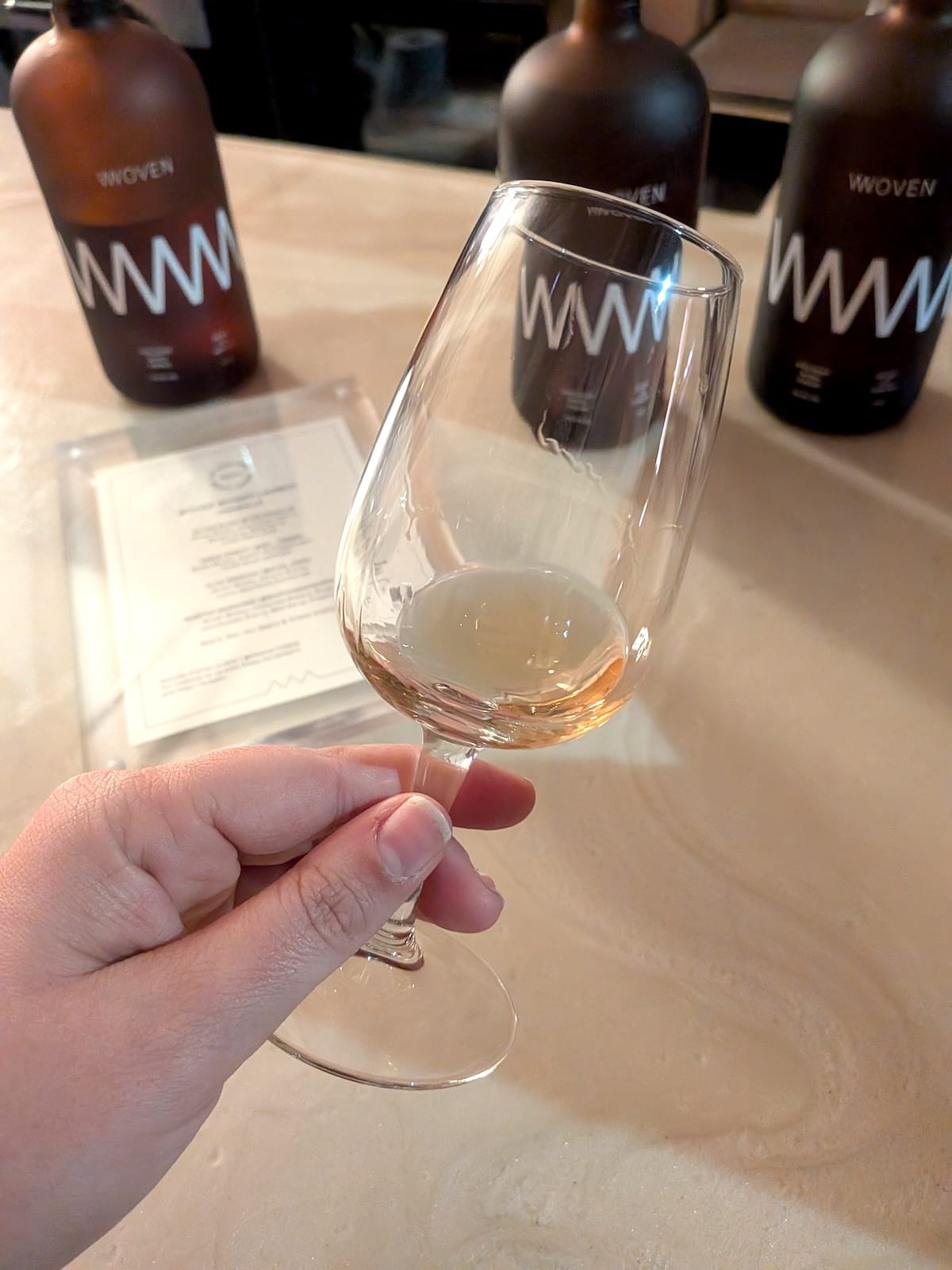
Woven is focused on blending whisky, not distilling it. So, they don’t have a distillery. Instead, they have a blending studio in Leith, in an old biscuit factory.
Their quote-unquote “blending house” is really more of a blending studio… and it’s one right out of my art school dreams. [Laughs] It’s creative and quirky and a little messy in the best way, rocking a white and yellow and raw wood color scheme going on…
Nearly every surface was covered in whisky bottles - the labels and naming conventions of which make it clear they’ve outgrown several neat little systems by this point.
And, well, if there was ever a common thread to the office of every independent brand that I’ve visited - that would be it.
So Pete pulled out a stool for me, poured a couple drams of whisky, and off we went…
-
Pete: We're trying combinations that have never been tried before. Ever. They probably never will be tried again. Because we're working with distilleries and combinations that you don't get. You know, a lot of blends are made by a single group that has 10, 15, 20 different distilleries. But when you add in distilleries from…
Caro: South Africa, Canada, Finland…
Pete: Exactly. You're suddenly making something that's never been made before. That's great. That's exciting. That's what I love.
Caro: I'm understanding why you have so many bottles in the studio right now. [Laughs]
Pete: Yeah, yeah. And then we talk about how we put them together. We try and be as gentle as we can. Just because I think it's important to be as gentle as you can.
So, it means no—50,000 liters a second pumps. It means being a bit more controlled, a bit more precise with how we're doing it. So you know, if we decide that a whiskey needs to be 115. 6 liters in that blend, then we don't say, 'Well, the cask is 140 so we'll just add that in.’
It means having a small amount left over and going shit— what do we do with this? And then using that for something else. But we find ways.
Being precise… because a lot of blends, although they can be precise on the table, aren't precise in real life because it's inefficient to waste… not waste, but to not disgorge a full cask. Do you know what I mean?
Caro: Yeah, absolutely.
-
After I interviewed Pete, I asked him to recommend a spot for dinner. He sent me to a great little wine bar with some small plates I’m still thinking about.
I had a great glass of wine and a lovely conversation with a guy who, fun side note - I ran into a week or so later at a different bar in Old Town. That’s how small Edinburgh feels sometimes.
After dinner, I made my way to a cocktail bar for a nightcap - and it was exactly the kind of spot that I love. One that could only exist in this time and place. The drinks menu literally told the story of the neighborhood.
And then I took a short tram ride, and an even shorter walk back to my temporary home.
This is a night I’ve had in cities around the world - a distillery visit or podcast interview, followed by dinner and some great drinks, and then maybe a tipsy walk home on cobblestone streets. Stopping into a bodega or tiendita or a konbini or a tabac - or whatever they call little shops locally - for a big bottle of bubbly water and a piece of chocolate to eat in bed.
And yet, the best cities put their own twist on that. Edinburgh certainly did, but I’d argue Leith did on its own as well.
And all of that history and context — it's the backdrop to what’s actually happening in Pete’s studio.
How blending works (25:00)
Pete: We are in constant conversations with distillers and brokers and groups on what they have, what they don't have. How much of it they've got, what the price is, blah blah blah, and we kind of make informed decisions. And we say, 'Let's get a sample of this,' 'Let's get a sample of that,' 'Let's try this,' 'Let's try that.' Essentially, that's what you see on my table here; it’s a lot of samples, not necessarily of whiskies that we own. We own quite a few of them, but not all of these.
And then we're able to say, 'Cool, we have this sample from this distillery.’ I do some sensory on it. The biggest thing for a blender is to understand what the whiskies are [that] you're playing with. Right? So you bring the whiskey, nose it, taste it, write your notes, try not to go too over the top with, you know, I'm getting slight cucumber, but it fades after. But to see where it sits within your general understanding of this is a really good example of a rye whisky that's got more spice than generally we'd anticipate, and it's got more wood coming in. So you go, okay, woody and spicy, great, get it. That kind of sits there…
If it's a good example of it, then you say, all right, I'll buy a couple of barrels of it or buy a barrel of it, whatever it is. And you'll bring that in. Again, do the sensory on the casks that you have. And then myself, Dunk, Nick, and the rest of the team, we've built our team now to… There are nine of us…
We sort of discuss kind of what we think we want to make and then I think that the task is really to say, well, I kind of understand what the stock is and what the abilities are of them, so I'll start playing around and start to construct whiskies from my side. This is probably not how, if we spoke to uh, one of those…
Caro: Third-generation…
Pete: [Both laughing] Yeah, exactly, they’d know how to put it together immediately. They say that, that, and that… off it goes. They'd have a spreadsheet within five minutes. I'm not that guy. I wish I was.
So, it's a lot of trial and error. Understanding what fluids go together, what don't. Um, and I take a little bit more of a, um, a structured approach to where I build a grid, where I'm combining. So, if I'm starting with a grain and a malt whisky. I'll do it at 50-50, 60-40, 70-30, 80-20, both directions. So you have more malt, more grain. To understand kind of where that buffer zone sits.
And for me, I'm looking at the texture first, rather than the flavour. The flavour will go in its direction, you know. That is, if you're using a grain whiskey and a distillery from, I don’t know, a sherry Speyside, that is going to taste very different from a grassy lowland or whatever it is. But I'll look for the best combination for texture. So, taking that basic combination, using that second component, then add other layers in.
So, that could be single malts. It could be whiskies from around the world; it could be grain whisky to sort of extend it, lengthen it. And that's where you're trying to say… I call it clarity, which I think is really important in a whiskey. I want you and I and the person beside you to agree that this whisky has got a banana and popcorn flavor to it, right? I don't want there to be a muddiness around it.
Caro: If I'm like, no, it's pear and smoke.
Pete: Yeah, exactly. If there's a big confusion, then it means that there's…
Caro: Yeah, if we all got stone fruit, okay. But if we got like tropical fruit… [cross-talk]
Pete: I'm cool with like everybody getting stone fruit. But if you get stone fruit and the person beside you says, 'No, it tastes like leather, and you know, grass.’ You'd be like, 'Something's fucked there.’
Caro: Your palate or the scotch—yeah.
Pete: So, clarity is really important. So I want a couple of notes just to jump out and for that to be at the top of the arc as you're drinking it.
And then the third piece is balance. In my view, a blended whisky needs to be one whisky that you're drinking and not seven or eight whiskies competing against each other in a glass.
Caro: That makes sense.
Pete: So those three things are kind of the three points. That I look for when making any whiskey. And then, you know, if it tastes good, then it's there. Then it goes through, you know?
Caro: [Both laughing] Such an afterthought - ‘does it taste good?’ at the very end.
Pete: Well, I mean, it is kind of that, because I think that if you concentrate on those three things, then you're making a well-constructed whiskey.
Caro: It's going to taste good, yeah.
Pete: I’m not responsible for the flavor. You can point it in the direction. You can guide it, but it's like sailing a boat. Or maybe it's not… [both laughing] but if it doesn't taste good, then it… doesn't get finished. You know, it's not going to be made.
So, you can have whiskies that have the texture, the balance, and the clarity that taste god-awful. Yeah, that's fine, but you're not going to taste them. You know, I didn't like it.
-
I didn’t come into this episode dismissing blended Scotch… but I do think I underestimated it.
It's 85% of all Scotch whisky sold. And when something is that ubiquitous, it's easy to flatten it in your head. Assume you know what you're getting. Especially when it's usually the cheapest option.
What I didn't fully reckon with is how much range is actually in there. In flavor, in style, in price — and yes, in quality. Blended Scotch isn't one thing. It never was. But somewhere along the way, we let it get written off as just that.
Flavor & Price (31:00)
Caro: So, do you make like the same amount of all of them? Or are there limitations based on how much you have of a certain whiskey that you're like, 'Oh, this is going to be a smaller batch'?
Pete: Exactly that. So your batch of whisky, and we do make batches, can only be as big as the smallest component, as the amount of the least component that you have, right? But everything is ratioed as well.
Caro: You got to do backwards math.
Pete: You have to do, you have to do three-dimensional math sometimes to figure it out. But it does make sense. You just, you can, you know, you know that. It's a lot of spreadsheets.
Um, but yeah, you sort of need to be able to know the practicalities, and also cost as well. You can't say, 'I'm gonna make this whisky because it tastes great but it costs…
Caro: It’s our three most expensive whiskeys.
Pete: 500 euro liquid cost whiskey… is, is not gonna like… Yeah, you can't make very much of it, and you can't sell very much of it. So you have to kind of know what you're wanting to do within the constraints of reality.
All the rest of it, I mean, we tend not to look at the price too much when we're making our whiskies. It might not shock you, but we buy finished whisky… that we then add process to, add time, add storage onto. Put it into a little bottle that is complicated to do. And then sell it, and expect to sell at a price that is affordable, or appealing, you know, to lots of people. And so… Our margin isn't sort of the driving factor; it's about: what can we deliver? And how can we deliver it in the way that we want to?
-
Talking to Pete about this, I couldn’t help but be struck by something that maybe should have felt obvious but…. Well, blended whisky is often expected to be the well drink. The bottom or mid-shelf option that is cheaper than the single malts on the shelf. But it’s made up of single malts… which is, nowadays, considered to be the premium, expensive stuff.
You’re adding grain whiskey to it, which is cheaper…. But still.
Woven costs around 40 or 50 pounds per bottle, which is about 53-67 US Dollars.
That’s twice as much as a bottle of blended scotch from the big boys… but also only 20-30 bucks more. And yet it’s produced at a great quality and waaay smaller scale.
One of the ways they meet this price/quality point is by looking to what has become known as “World Whiskies.”
World Whisky (33:38)
Pete: There’s such a magnifying glass in Scotland, but all of the whiskey-drinking countries are now making whiskey, and the flavour profile that you get in Scotland is all the shades of one color, right? But if you take that lens out, if I can stretch the metaphor, then you suddenly have a full spectrum, and so looking at whiskies from around the world and being able to sort of come at it with that with that with that lens was really, really exciting for us.
-
Now, if you’ve listened to any of my previous whisky episodes - you already know that there’s this category of whisky-producing countries called “New World Whisky.”
This basically refers to every country that isn’t an OG or Japan - so, Scotland, Ireland, the US, Canada, and then Japan, because Japan, while not an OG, is an exception to everything.
And there’s sometimes some… I don’t want to say shade because that’s too strong, but some haughtiness or something toward whiskies coming from other places.
And, look, some of them are very new and raw and figuring things out. They may not hold up to the quality of these long-running brands or whisky-producing communities that have been around for hundreds of years.
But sometimes, even when they are really good, they’re just different. And I feel like the whisky world requires them to do a lot of work to prove themselves.
This isn’t unique to whisky - wine has similar tension, in my opinion - but sometimes the snobbery found in certain corners of whisky comes out particularly hard here. And, also, because of who the OG countries are and the colonial dynamics baked into that history, it can read even a little more offensive.
-
Pete: If you look at New World whiskey, and by New World I'm talking outside of Scotland, Ireland, America, and Japan, right? Put them to one side.
You have countless people, places, and communities that drink, engage, and love whisky. And a percentage of them want to be able to make whisky as well. And within that sub-sector, you really have three types of New World distiller.
You have the one that says, “I am based in this landmark place, and so I want to make a whiskey to associate to Timbuktu, or the most northerly, or the deepest, or whatever it is… and you go to that distillery, and you get a bottle. You say, 'I have a bottle from this place.' Fine.
The second type are those that fell in love with Scotch whiskey, or Irish whiskey, or American or Japanese, whatever it is, and they want to recreate that where they are. And that's fantastic because they’re making, you know, cool whiskey, great whiskey… but I can get fantastic Scotch, Irish, and American from those respective countries.
But the third type is the one that I am really interested in. Those are the people and communities that have philosophies, ideas of making, production methods, and ingredients that create a sense of place in the glass that is unique to them.
You mentioned the Kyro distillery in Finland. They use a small and hardy rye that only grows for a few months in the year; that's synonymous with that location and is a really popular flavor across Finland, but was not representative of whisky until they started to make it.
And they're using alder wood, which is what they use to make their saunas out of, in order to smoke the rye. Those guys are working with the hardships and the nuances of where they are to create something that tastes unique to them and I think that is, truly, if you look back and you want to understand kind of what whisky means to the communities that make it… Those guys are showing it more than a lot of the Scotch, Irish, and American are today.
And so I would say that alone is a reason to use world whiskies.
-
I’m interrupting this great passage from Pete to just say: ONCE MORE FOR EVERYONE IN THE BACK.
Now, back to Pete.
-
Pete: I also think that the flavor map expands massively. As soon as you… So, Scotch whiskey has 150-something distilleries now. I can't remember. I used to know it…
Caro: Too much whisky? [Laughs]
Pete: Yeah, [there are] 150-something distilleries and that flavor map in Scotland is growing, and that's amazing. So, you're getting distilleries pushing boundaries, trying new things that are making things more concentrated, or looking for flavor to come from. So, that’s amazing.
But in Scotland, you have a lot of limitations because that's how Scotch is made and that's what the rules mean that you're able to do. Same with Ireland, same with America, same with Japan.
And as soon as you walk out of those doors, you're able to find people that are truly experimenting with amazing things, techniques, and processes.
I was down in Armagnac a couple of weeks ago with some whiskey distillers down there. And they're taking their knowledge from Armagnac and converting it into whisky, to be able to get these incredible esters and beautiful flavours coming through their whisky that I haven't seen anywhere else.
And that's because they're looking at it from a wider point of view— Armagnac, well, Cognac and brandy, I should say, wider point of view. And I think that's really, really cool. And that's one location in one country.
And, so, I think that there's a lot more possibility outside of one country, and so I think that to be a contemporary blender, to be a contemporary whiskey, it shouldn't be constrained to one country. Because it doesn't need to be.
Before, it was because these… the only whiskey that was being made really was in Scotland that they could get their hands on.
But we're able to get amazing whiskeys from Mexico, using single-grain, single-corn varietals that create a flavor that's unique, that are a thousand years old.
Why would I not be so excited about that? Why would I not want to see how this interacts with some beautiful single malt from Scotland? Or a really jammy Australian cask? Or something else, you know? How would this taste with a little bit of Islay coming across it to bridge? That would be beautiful. Could be. Might be shy. Don't know.
Caro: I was in Kanosuke’s distillery in Kagoshima, Japan, earlier this year, and they're using shochu practices in the distillery, but also like a copper pot still, and like you know, they're doing all kinds of crazy shit. And when you have that lens of like, we've been making shochu for generations, and we're in this warm climate. And, you know, our whiskey can mature faster. It's just…
That's what I want more of. For people to fuck around and find out, you know? It's like, what happens when we make whiskey out of this thousand-year-old corn? When we use a shochu tank?
Pete: This comes back to we're not content with what whiskey is. We want to know what whiskey can be. And in order to answer that question, you need to go to the guys that are also asking the same questions around the world. And there's lots of them.
They're also doing it in Scotland. Please. We use a lot of Scotch whisky. We love the distilleries in Scotland. Absolutely masters of the craft, but there are also other people.
Caro: Yeah, there's room at the table.
Pete: Of course, there is a big table, a big table.
-
When you talk about technological advancements in an industry as old as whisky, sometimes you lose track of just how long that horizon line is. Like, yes, we can use the fancy computers and stills and temperature-controlled warehouse… but we also now have international shipping that doesn’t take months.
And professional communities that transcend borders in a way that allows whisky makers from different corners of the world to learn from each other and to just… send each other their whisky.
And it’s here I want to read a bit from Woven’s own website:
“All of these whiskies eventually find their way to our blending table in Leith. It’s not always straightforward. Sometimes weeks pass waiting for customs clearance or lost samples. When the packages finally arrive, they’ve travelled halfway across the world, processed through countless hands.
The air inside the studio changes when they’re opened — unfamiliar scents of heat and wood and newspaper ink in unreadable languages. Even the packing materials carry a sense of place. It’s a reminder that what we’re doing couldn’t have existed a generation ago.”
This is from the description of their Pure Malt whisky, which is part of their core range, and this is what’s in it:
- Blended Scotch from Speyside, or northern Scotland
- Australian single malt
- Indian single malt
- And Taiwanese single malt.
I mean, what a cool combo! And so representative of what Pete means when he says that these are blends that didn’t and couldn’t have existed ages ago — and may never be made again.
But that doesn’t mean we should hoard them on our bar cart…
Core Range (42:50)
Woven has a core range of four whiskies. This includes the Pure Malt I just mentioned, and a newer addition that’s their unofficial “house blend.”
The world of whisky has largely been defined by prestigious single malts and fancy age statements in recent years. Bottles you collect, give a pride of place on your bar cart, and rarely (if ever) actually open. But this house blend is the opposite of that. It’s a bottle you’re meant to open.
As they put it: “It’s whisky for weekday dinners, group hangs, or solo sips. No ceremony required.”
-
Pete: I think that we've been learning with every single release. We've done 24 limited releases. We've got four whiskies that we've made again and again and we've spoken to thousands of people about things they like, things they don't like, getting feedback, understanding ways that we're making whiskey, finding out ways people are enjoying whiskey, and I think that… coming out initially and saying, ‘this is our whisky’ is really hard. Because you are pinning your colors to a mast and you've got no idea where it's going.
And so we decided that we wanted to wait and create something that was kind of the culmination of learning. And so we’ve made our house blend… It’s called Woven Whiskey originally, and it sort of stands for what we are now, which I think is really cool.
First of all, just to frame this up slightly, the world has shifted quite a lot in five years, as I'm sure that you and most of us have. We have a very different, not to get deep, very different political map. We also have very different wallets and pockets.
I think that when we started, it was all about the very expensive prestige, ‘only a few bottles of this are made, and how can I get one?’
Caro: Fancy age statements.
Pete: Exactly, exactly, exactly.
And I think that today we're seeing a shift, seeing a real shift in consumers saying: I want to have something that delivers on flavour but isn't breaking my bank. And that's becoming much more apparent today than it was a couple of years ago.
And we wanted to make a whisky that was designed for drinking and designed for taking off the cap, throwing it away and pouring and sharing with your friends and having, as when you get back from a shit day at work, or you know, or on a Sunday when you're watching the rugby or football, whatever you know… We wanted to make an everyday whiskey that delivered beyond its price in flavor. Now that's a really important piece there that delivers beyond its price in flavor.
Because the price is almost dictated by Scotch. Right?
So, we did that by looking outside of Scotch. For big flavor that delivered beyond its price, and so we looked at well, we talked a little bit about corn whiskey already, but we looked at corn whiskey being a huge delivery on flavor at affordable prices.
We went to two different sources. We went to Canada - cold climate, into sherry, so you're getting wonderful body and nuanced bodies; it's a little bit more nuanced. It's robust and bold, so it's corn, but still with that lens of sherry coming through. Pedro Jimenez, predominantly, so a sweeter style.
And then down to South Africa, very different climate, very different producer. You know, delivering massive, massive flavor at quite a young age and being able to combine those together, so layering the two— from the cold and the hot climate— being able to sort of accentuate that banana, that buttered popcorn flavor, that you can get from these things, was really core.
And then layering in some malt whisky from Scotland again, in sherry, so we wanted to have a sweeter style of whiskey— one that everybody can go, “Well, I do like you know… It's sweet whiskey that's yummy, that's nice.” And then having the elegance of some Irish wheat-based grain as well.
There's a layer on top to almost add silk to the— you know, putting silk over it to make it very, very smooth. Was kind of the ambition.
Pete: Want to try?
Caro: Yeah, sure.
Coffee Spirit (47:30)
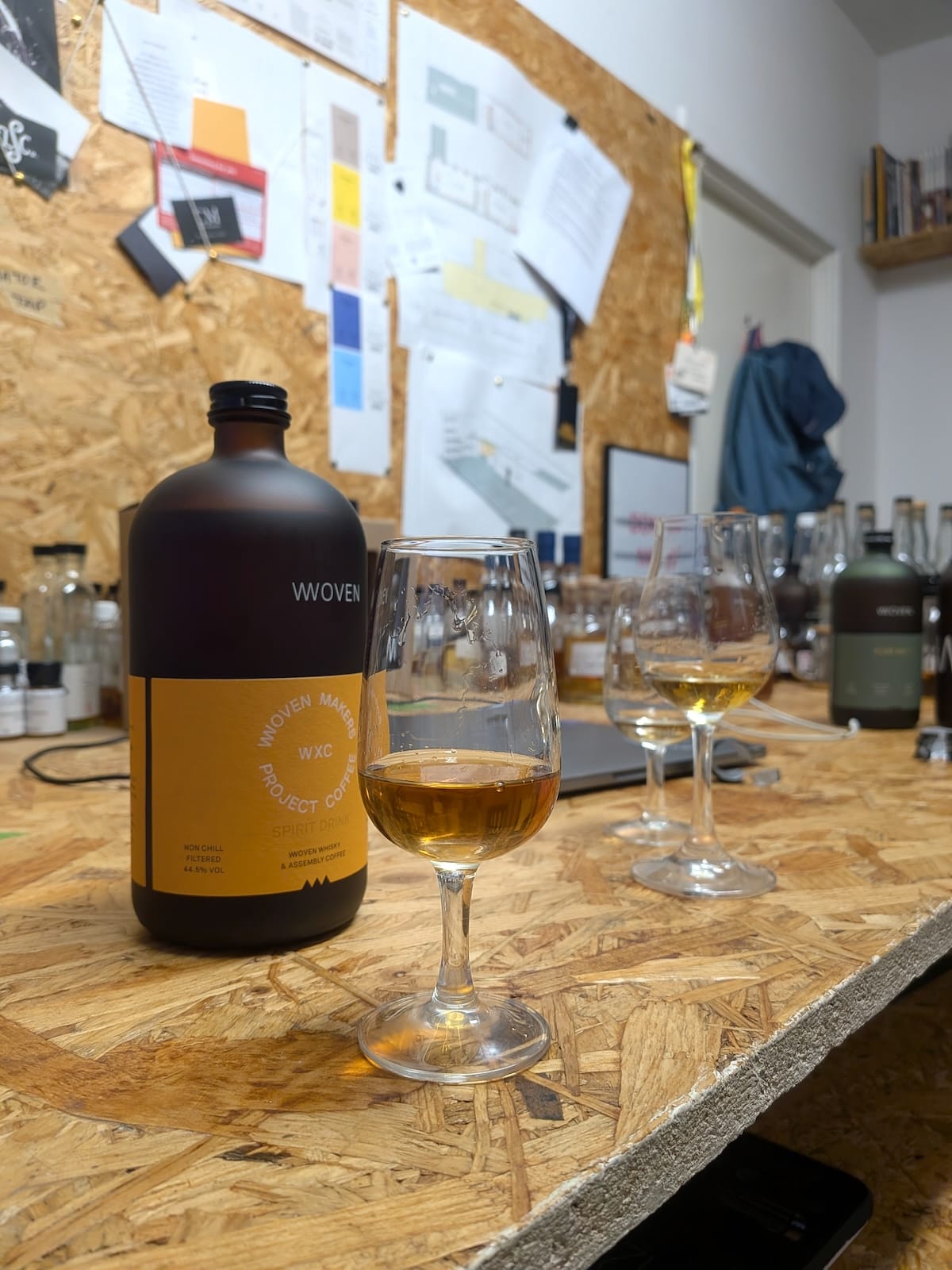
There's one more thing in the Woven range I need to mention: their WXC coffee spirit, which is technically not whisky at all.
It’s called WXC… Woven x Coffee… and legally it’s a quote-unquote “spirit drink,” which is one of those terms that I only ever expect to see from big corporations doing shady shit to really cut corners… and also super small, cool brands like Woven, doing really neat stuff (heh heh) that doesn’t neatly fit into existing categories and regulations.
-
Pete: Obviously, I became fixated with coffee in the same way that one does in their 30s, and I love the combination of whiskey and coffee. I think it works very well when done well.
We started working… well, we made friends, I should say, with a woman called Claire Wallace from Assembly Roast down in London, one of the best coffee roasters in the world. The specialty is getting coffees from the most incredible growers. They have great relationships.
She loves whiskey, and I love coffee, and we decided it would be a good idea to make something together. There was just going to be, you know, 100 bottles, or something really, really small. But we kind of went around it by looking at what coffees they were able to source and how that interacted with whiskey.
Cut a long story short… We tried about 30-40 coffees. We actually found that the more acidic, the more complex, the more kind of, specialty, as it were… The way more spiky when you started to play with coffee and those flavors. And, so, you wanted something that had kind of the banana, potassium, and pineapple, and the guava, as opposed to the red currant and the blueberry and the acidity that you can get from some coffees. So, this is much more around that softer fruit, that more kind of ripe fruit, as opposed to berry fruit.
We created a cold brew with that, using the Scottish water, as opposed to the London water. Doing it for a very specific amount of time, ensuring that everybody was pissed off because they had to be up at three o'clock in the morning to stir it, and all this sort of stuff.
Then blended whiskey around that flavor, in order to essentially take the cask-strength whiskey, which is a combination of some grain whiskey from North British and some Glen Elgin, so it's a very simple, quite one-dimensional blend. Then bring the cask-strength whiskey down to bottling strength with the coffee.
This isn't a sweetened product. It's not a liqueur. It's at 44.5% ABV. So, it’s big, proper whiskey.
The ambition was to get a product that… If you're a whiskey lover, you think that it's coffee-led. And if you're a coffee lover, you think it's whiskey-led. But it should be on that knife-edge between the two.
-
And how cool is that?
It reminds me of being in art school, sitting around a coffee table with friends from different disciplines, creating excuses to work together because we had a cool idea and wanted to, and not because there was some high-handed business synergy.
In fact, Pete was nice enough to send me home with a bottle of both WXC and the house blend and - maybe contrary to his whole statement here about popping it open and throwing away the cap… I found myself feeling kind of precious about it for a second there.
Which is also completely antithetical to how I treat spirits. Very rarely will you see me hoard or preserve a bottle — “Respectful, not precious” is my motto when it comes to even the rare stuff.
So, I was fighting the urge to save my bottles of Woven, since I can’t buy more here in Mexico.
And then, a couple of weeks after I had gotten back, I had a bunch of people over for the holidays, and maybe by midnight or so, most people had left, but there were five of us sitting around my coffee table - a couple of friends who work in mezcal, but all drink nerds of some kind, and we started talking about my trip…. And before you know it, my Woven bottles are out. The caps are popped.
I wanted these friends who love drinks as much as I do to try these bottles from Woven that I loved, but I also just wanted to end a fun, chill night with a great drink.
And, well, if Woven doesn’t start exporting to Mexico soon, I guess I’ll just have to keep planning regular trips back to refill my stock…
Wrap-Up (52:15)
You already know I love producers who marry tradition and experimentation, who fuck around and find out, as I often put it… Woven is that, and all of their whiskies fall somewhat into this spectrum, but especially the coffee spirit.
They’re a small group of friends who love whisky, making whisky in this really traditional, historic place… but looking beyond its corners to do something new - to write their own footnote or chapter, if you will.
If you ever have a chance to pick up a bottle, I highly recommend giving it a try.
Woven is available in dozens of countries around the world - mostly in Europe, but also in South Africa, and a growing number of places. I’ll throw up a list on my website at betweendrinks.co/blendedscotch with links on where to buy it.
Plus, I’ll include all the other places and people I mentioned in this episode, and even some recs on where to eat, drink, and visit on your own trip.
And, if you’re new to Between Drinks, make sure you also sign up for my newsletter while you’re there. It goes out a couple of times a month with mini-episodes and all the fun stories behind the making of this podcast. If you like the show, you’ll like it, I promise.
You can subscribe at that same link: betweendrinks.co/blendedscotch.
Thanks so much for listening, and I hope to see you for the next episode as we dive further into the great drinks coming out of Scotland!
But before we go, I’ll leave you with one last pro tip from Pete…
Pete’s Drink (53:30)
Pete: I mean, I'm a whiskey blender. I typically drink my whiskey in very small amounts through my nose. If I'm honest with you.
Actually, you know what I'm doing right now? I'm drinking Long Manhattans. Absolutely, my drink of the year.
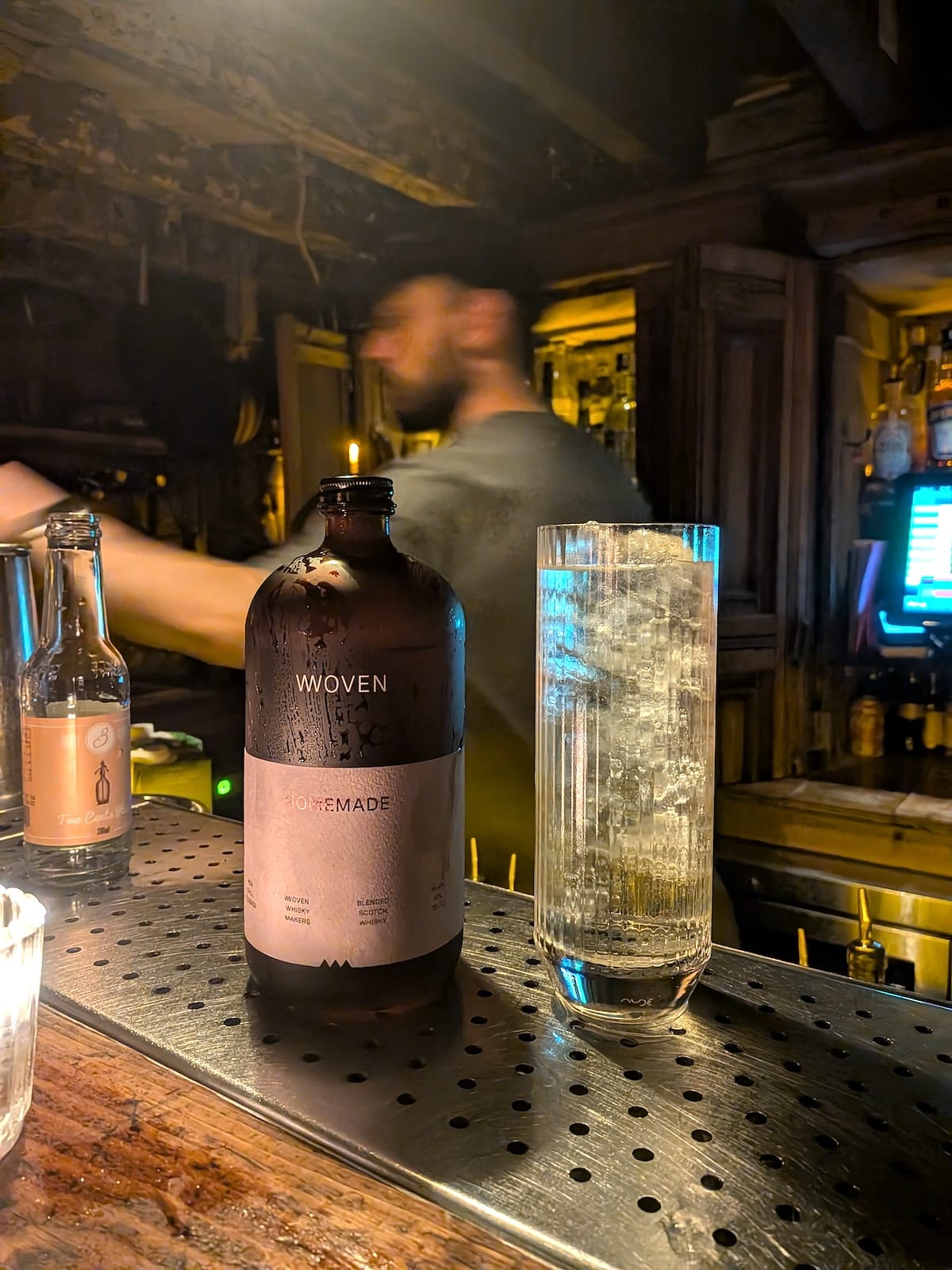
You might like a perfect Manhattan, dry or wet Manhattan, whatever it is— but make your Manhattan, lengthen it with some tonic water or some soda. It's unreal. It's so good. It's so refreshing. It's beautiful. And it's great.
So drink that, definitely…
Show Notes
- Woven Whisky
- Pete Allison on Instagram: @malted_pete
- Woven Whisky on Instagram — @wovenwhisky
- Assembly Roast and Claire Wallace - collaborators on Woven's WXC coffee "spirit drink"
- Kyrö — Finnish distillery as an example of "world whisky" doing something genuinely new
- Kanosuke — Japanese distillery as another example of producers who are bringing a unique approach to whisky making
Subscribe
Subscribe to the show in your favorite podcast player to make sure you never miss an episode.
And maybe leave a rating/review while you're there? 🙏
Related Episodes
 Caro Griffin
 Caro Griffin
 Caro Griffin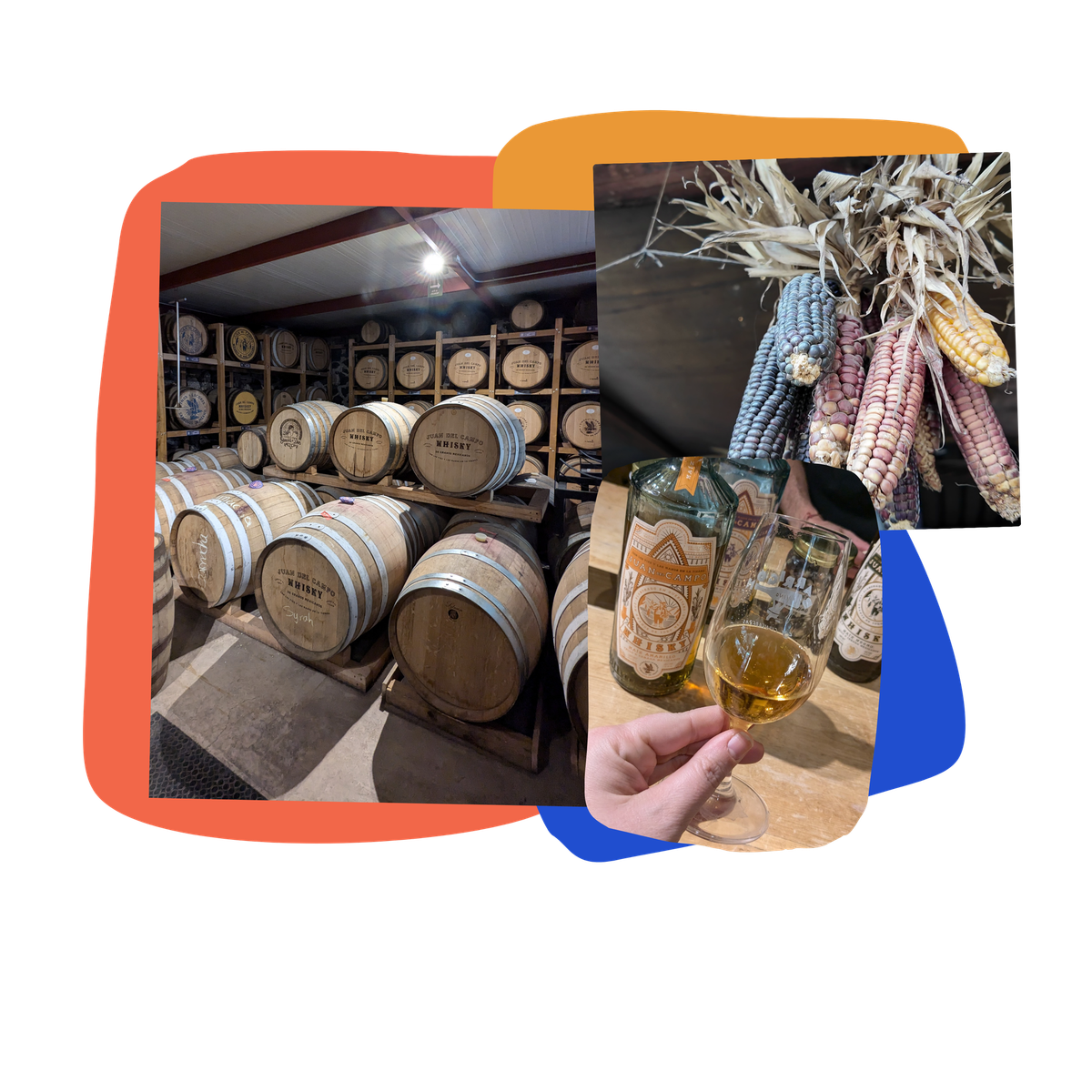
I've spent a few too many nights exploring its great cocktail bars. Check out a few of my favorites.